
Once again, Translation Day is here. And once again, we're celebrating by interviewing a translator. In previous chapters we've interviewed professionals in various languages (you can find the interviews here ), but it's clear that my favorite is Chinese. So, this year I'm going back to my original language and culture and interviewing Carles Prado-Fonts, an expert in Chinese language and culture who does excellent translations into Catalan.
However, Carles is not only dedicated to translation. As we have said on other occasions, Chinese experts usually combine several tasks, which can range from teaching to translation, mediation or interpretation, among other things. Today we will review the areas that our guest is most involved in, starting with his training.
In his case, he has a degree in translation and interpretation of French and Chinese, studies that he took at the UAB, as a server. This is where the similarities between our trainings end, since I opted for English while Carles decided to expand his knowledge of China and Asia. Thus, he did a master's degree in Contemporary Chinese Cultural Studies (University of Westminster), he has a doctorate in Translation Theory and Intercultural Studies (UAB) and he also has a doctorate in Asian Languages and Cultures (University of California, Los Angeles). As we will see below, some of his works as an author have to do with these studies.
Let's go!

Let's start at the beginning: Carles, you have a degree in Chinese translation and interpretation, but your academic career goes beyond translation and you also have a master's degree and two doctorates, all focused on the field of Chinese and Asian culture and related fields. The first question, then, is mandatory: what attracted you to Chinese to the point of making you choose it as a career?
The truth is that I don't really know! As a child I never had any special interest in the Eastern world. I really liked languages, yes. But not so much for what the linguistic skills themselves would be, but rather for everything that exists beyond the language. I have always been very curious about learning things and I suppose I have liked languages as a gateway to other cultures, literatures, histories... Languages make you learn and think differently, which is another thing that I have always liked too.
But I rationalized all of this afterwards. Honestly, when it came time to choose a career, I wasn't really sure what to choose. I had a feeling that it would be good to study something related to languages, literature, history, humanities. And I wanted it to be difficult or to pose a certain challenge. Then my friend (and great translator!) Albert Nolla, who is a year older than me, gave me good publicity about studying Japanese at the UAB, as part of the degree in translation. I tried to emulate him, but the places on the Japanese route were already sold out. Then I opted for Chinese.
From there, the Chinese world became more and more interesting to me, especially thanks to professors like Seán Golden. And after a stay in China I decided to try to pursue an academic career in this field and I have been lucky enough to be able to dedicate myself to it. I consider myself very lucky because the academic world and the Chinese world allow me to do what, deep down, I have always liked: reading, writing and continuing to learn things.
I would like to review with you some of the professional facets that you develop, and I would like to start with the teaching facet. You have taught at the UAB, the UPF, the UOC, UCLA and the Beijing Language and Culture University (BLCU), and I assume that you have taught subjects on various topics: Chinese literature, translation... Which one or which do you like teaching the most?
I like them all: I love teaching! I really enjoy sharing what I've learned with students and trying to instill in them a curiosity for things we don't know and a passion for learning. Seeing them grow as students and researchers is amazing. It may not be the most common thing in the academic world, which has quite feudal inertia, but I get excited when I see how students progress and manage to surpass the skills and knowledge of their teachers. If I had to choose a specific subject, since my specialty is literature, I would probably say that it's the one I like teaching the most. But I also really enjoy teaching everything that has to do with history, thought or culture in general.
As part of your academic side, apart from teaching, you carry out an important research activity. In your case, this activity that is often hidden in drawers or in publications of very restricted scope has seen the light of day in two very interesting books. The first is Regresar a China , a book that we already discussed in this blog and that brings us closer to China through the eyes of three authors who went to study abroad and who later returned home. What made you choose this topic?

The origin of Regresar a China is in my predoctoral research. For many years I researched the phenomenon of Chinese writers who during the first decades of the 20th century went to other countries to study and, later, returned to China. It is a topic that interested me for several reasons: because it involved thousands of young people, because it had consequences in many cultural, intellectual and political aspects. And I suppose also because at that time I was also studying abroad and I empathized with these young Chinese who had to return to their country, even if it was in a very different time and context from mine. I worked on this topic for more than ten years, with two doctoral theses and some academic publications. Then I thought that, to close the project, I could make a more essay-like book like Regresar a China that would make this topic known to a less specialized reader.
In your second book, Secondhand China , which you recently published, you talk about the way China was perceived in our country at the turn of the 20th century, a time when much of the information we received came to us through bridge cultures. Why did you choose this era? Do you think what you discuss in the book is still valid?
Yes, in the book I basically explain how the image of China and the Chinese that we forged in Catalonia and Spain at the beginning of the 20th century was very much determined by previous images existing in other languages such as English or French. I focused on this period because it is a topic and a period that we decided to investigate in a collective research project with colleagues from the ALTER group. It seemed to us that it was an important time for relations between China and the world, and that the contacts that existed at that time had been less studied than those of previous and subsequent periods. But it is a very valid phenomenon today. Although it is now easier to access China directly in many ways, the way we imagine China and the Chinese is still very indirect, in the sense that it follows what is circulating in other, more hegemonic cultures.
Let's bring all this to a specific field, that of publishing Chinese authors. Does this vision that we discussed in the previous question influence the selection of literature to translate from Chinese?

Very! It is very difficult to find a Chinese work that is published in Catalan or Spanish and that has not been selected, translated and published before, generally with some success, in English, French or German. This is not bad in itself, because it is a mechanism that, after all, facilitates our access to Chinese authors. But we must be aware that it imposes on us a certain view of China that is not exactly our own and that does not always fit our reality or our interests. A very clear example is what is happening today in Hong Kong, Xinjiang or Taiwan. These are events that should have a very intense echo in Catalonia, because there are many similarities between the respective processes of political oppression. But since information about China reaches us mediated by the English- or French-speaking media, for which these similarities are not so obvious or so important, it is not surprising that they have a lesser echo. To Anglophone or Francophone public opinion, what happens in Hong Kong, Xinjiang or Taiwan is more interesting in terms of geopolitical or global governance and not so much in relation to political and individual freedoms.
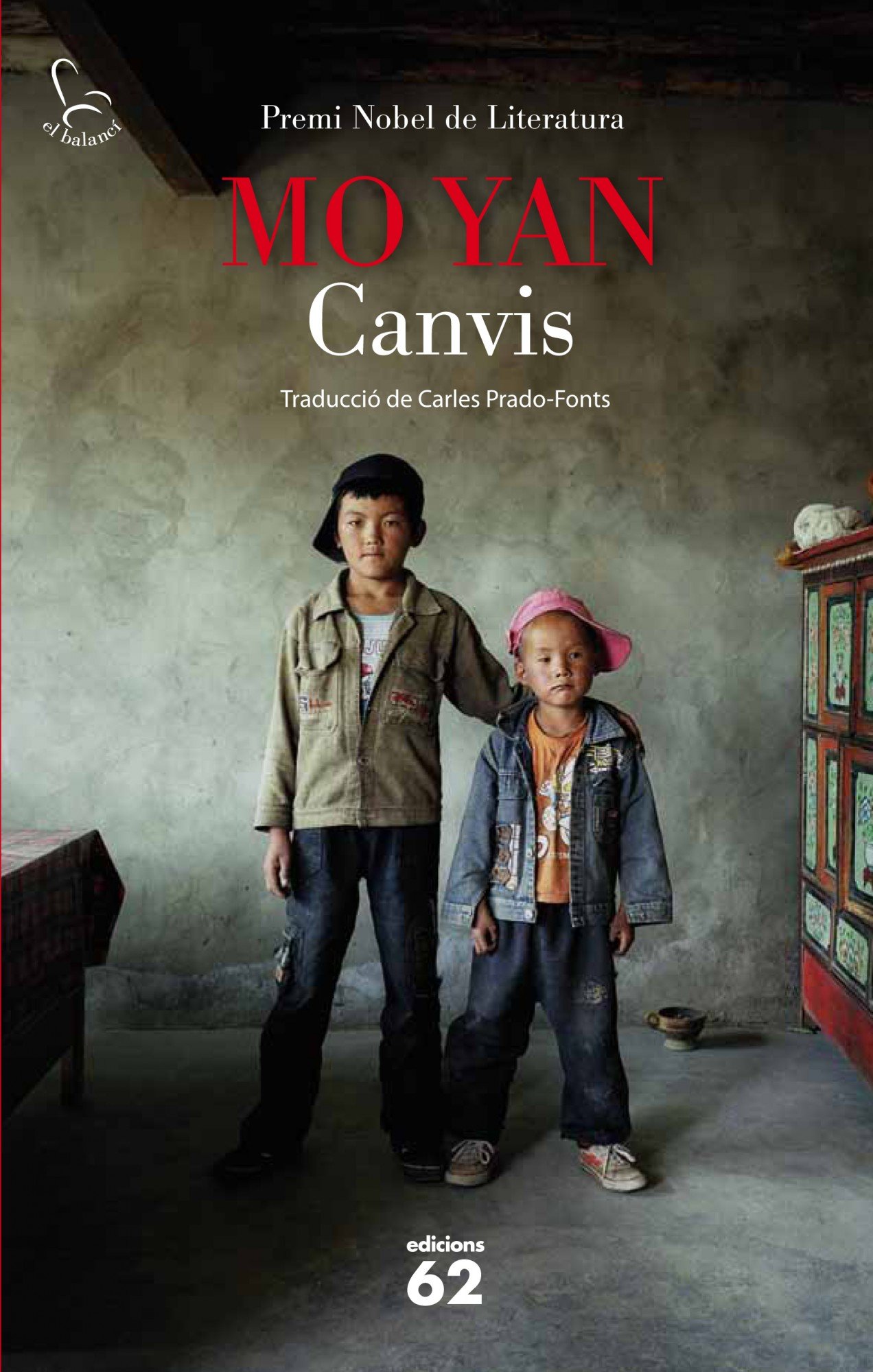
Apart from your facet as a researcher and as an author, there is a re-creative facet: that of a translator. In fact, this is the one that may make you better known among the general public. As far as I know, three of your translations have been published, and I would say that each one reflects a key moment in Chinese literature: a collection of legends, which would take us to the founding era; a collection of stories by Lu Xun, which would take us to the moment of change between traditional and modern China, and a non-fiction book by Mo Yan, which reflects a fairly recent time in his country. Do you have a favorite?
The truth is that I would love to translate more, because I find it a very focused activity that allows you to immerse yourself in the text and make an interpretation of it that is still creative. But I can only dedicate myself to it from time to time, when I can link a translation project with academic activity. In fact, this has an element of privilege: since I do not translate professionally, I can afford to choose the translations I do very carefully. I also really enjoy translating because it requires a very different mental gymnastics from that required by research or academic writing. They are activities that require very different efforts and complement each other very well.
Regarding preferences, in addition to these three translations in book format, I also translated a short story by the writer Lin Huiyin for a dossier in the magazine Lectora on women in East Asia coordinated by Professor Pau Pitarch. It is entitled “A trenta-set graus” and is a beautiful piece, in a modernist style, published in 1934. If I had to choose one, I would say that this would be my favorite. Also, on another note, I really liked the short essay “Després de la Postguerra Freda” by the philosopher Dai Jinhua that I translated a couple of years ago for L'Espill .
If we go back to the three books we mentioned above, I suppose that all three must have very different characteristics. Pan Gu Creates the Universe brings legends and myths, while Diary of a Madman by Lu Xun is a major work that reflects a moment of change in Chinese society and, also, in the way of writing. Finally, Changes by Mo Yan seems to be a closer writing… Which one posed the most difficulties for you when translating? Or would you say that each one has its complications?
They were all difficult in their own way. The collection of myths and legends was a challenge because it was the first translation that I linked to research work I had done for my doctorate. Lu Xun's stories were the most difficult to translate because Lu Xun writes in a modern language that is still in the process of formation. And also because his work has great historical and existential depth and I suffered a lot so that the translation would somehow convey this gravity. Mo Yan's novel is not particularly difficult on a linguistic level, especially if we compare it to other works of his! But it was an assignment following the awarding of the Nobel Prize and the publisher gave me ten days to translate it. Although it is a fairly short novel, this had its point of difficulty.


To close, could you tell us a little about what you're up to now? Research, write, translate... do you have any projects in mind?
I am currently still finishing the project that Secondhand China is part of. Although the book has already been published and that is, in a way, the end, I still have a couple of academic pieces on the subject in progress. And, on the other hand, since this research is part of a research group project, we still have to finish it completely collectively. Then it will be time to open a new project, which I am not entirely clear about yet, although I would like it to be more focused on Chinese and Sinophone literature again.
Thank you very much for everything you have told us, Carles. Once again, we have seen that the Chinese specialist can have many faces. We look forward to continuing to read you and take this opportunity to wish you a very happy Translation Day!


